

 Bob Scott
Last Updated: November 21, 2026
Quick Summary
Customizable storage systems for bass boats are worth it because they turn storage into a speed problem you can solve: every bait stays visible, hooks stay secure in rough water, and you grab a lure in one motion. Easy View Tackle’s system customizes to your boat’s compartments and lids, so it fits your boat and your fishing style.
- Measure inside depth, usable flat surface, lid swing and latch clearance, and bait hang length in inches per compartment.
- Foam-filled crankbait hangers protect hooks by hanging baits individually instead of piling them together.
- Clip strips keep soft plastics, spinnerbaits, and buzzbaits hanging in place instead of fused in a pile.
- Choose adhesive mounting for smooth surfaces you are testing and screw mounting for committed, high-vibration surfaces.
- Let adhesive fully cure before loading baits, then re-check every mount after your first rough-water run.
Table of Contents
- Why Bass Boat Storage Ideas Fail When the Bite Is On
- What Makes Bass Boat Tackle Storage Actually Work
- Crankbait Storage for Boats: Foam Hangers That Protect Hooks
- Soft Plastic Storage on a Bass Boat Without the Mess
- How Customizable Storage Systems Fit Your Boat Layout
- Installation, Durability, and What to Check Before You Mount
- Rig Your Boat with Easy View Tackle This Season
- Frequently Asked Questions
Why Bass Boat Storage Ideas Fail When the Bite Is On
Most bass boat storage ideas look great in the driveway and fall apart the moment a school of fish blows up on a point.
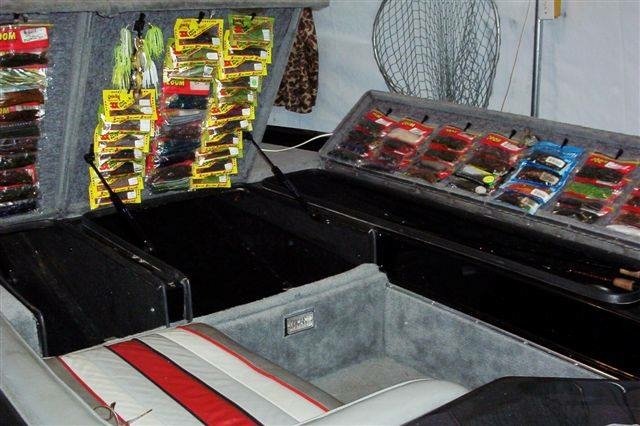
Storage on a bass boat is often treated as a space problem, but it is really a speed problem. Storage on a bass boat is actually a speed problem.
Traditional tackle boxes and trays fail that test for three reasons:
- Baits sit stacked on top of each other, so hooks tangle and you dig for the one you want.
- Trays hide everything below the top layer, which means lifting, sorting, and re-stacking.
- Loose plastics slide to the back of the compartment and vanish until you clean out the boat.
When a limit fish hits a crankbait you already own but cannot find in ten seconds, the storage system cost you the fish. That is the problem worth solving.
What Makes Bass Boat Tackle Storage Actually Work
Good bass boat tackle storage does three jobs: it keeps every bait visible, holds hooks secure when the hull slams through chop, and lets you grab a lure in one motion. Miss any of those and the system adds work instead of removing it.
Visibility comes first. If you have to unclip a box, flip a lid, and rummage, the storage is hiding your tackle rather than storing it. A bait you can see is a bait you will throw.
Security matters just as much. Rough water shakes loose hardware, and a crankbait that rattles free can bury a treble hook in a glove or a cushion.
Speed ties it together. The best layout puts your most-used baits where your hand naturally falls, and the seasonal stuff deeper in the compartment.
Crankbait Storage for Boats: Foam Hangers That Protect Hooks
Crankbait storage for boats comes down to one question: how do you keep treble hooks from tangling while keeping the bait ready to cast? The answer is hanging baits individually instead of piling them together.
Foam-filled crankbait hangers are designed to protect hooks, helping keep hooks from being damaged.
A common mistake is stuffing crankbaits into compartments by size rather than by use. You can see the actual crank bait hanger we build to understand how the foam grips a bait without touching the hooks.
Soft Plastic Storage on a Bass Boat Without the Mess
Soft plastic storage on a bass boat falls apart because plastics do not hold a shape.
Clip strips fix that by hanging each bait or bag in place.
Hanging soft plastics keeps them off the deck and away from pooled water. If you want a deeper walkthrough, we wrote a full guide on how to organize soft plastics on your bass boat without the mess.
How Customizable Storage Systems Fit Your Boat Layout
Easy View Tackle’s system lets you customize storage to your boat’s compartments and lids, so it can fit your boat and your fishing style. A repeatable fitment process helps you plan a layout that matches how you actually fish.
Measure before you mount
Fitment comes down to four measurements per compartment, and you want them in inches because that is how hardware and lid clearance are specified:
- Inside depth: from the compartment floor to the underside of the closed lid. This is your hard ceiling. A mounted hanger plus a hanging bait has to clear it.
- Usable flat surface: the largest uninterrupted flat area on the compartment wall or floor where adhesive or screw hardware can sit. Curved, ribbed, or carpeted surfaces change your mounting choice.
- Lid swing and latch clearance: open the lid fully and note where hinges, latches, and gas struts travel. A hanger mounted too close to a hinge can be crushed when the lid closes.
- Bait hang length: the distance from the mount point to the bottom of the longest bait you plan to hang there. Crankbaits, spinnerbaits, and buzzbaits hang to different depths, so measure your longest bait, not an average.
Write those four numbers on a piece of tape inside each compartment. When you compare layouts, you are comparing numbers, not guesses.
Match the layout to your boat’s compartments
Bass boat layouts present different mounting surfaces, and the same system configures differently in each:
- Front deck compartments: usually shallow and wide, with lids that close tight. These favor hangers mounted on the compartment wall or under the lid, with baits hanging parallel to the lid so they clear when it shuts. This is where your high-use crankbaits belong, because it is closest to your casting position.
- Center console and cockpit areas: more vertical surface and more foot traffic. Clip strips mounted on a vertical face keep soft plastics, spinnerbaits, and buzzbaits out of the walkway and readable at a glance.
- Built-in seat-top and cooler-lid compartments: often the tightest lids on the boat. Confirm lid clearance first; if the gap is too small for a hanging bait, move that layout to a deeper compartment rather than forcing it.
- Rod locker and side compartments: longer and narrower, which suits a row of clip strips running lengthwise so baits hang in a single line you can scan.
Match the layout to your fishing style
Once the measurements clear, the layout is a priority decision:
- Crankbait-heavy angler: cluster foam-filled crankbait hangers in the compartment closest to the casting deck, grouped by diving depth and color family so you can read the row and pick by the conditions.
- Plastics most of the day: run clip strips under the lid where your hand falls naturally, so a stickbait or swimbait comes out in one motion without lifting a tray.
- Tournament setup: high-use baits up front and visible, seasonal backups deeper in the boat, so the baits you throw every twenty minutes never sit behind the ones you throw twice a season.
Watch out: measuring depth to the lid but forgetting the latch or hinge travel is the most common fitment mistake. A hanger that clears the flat part of the lid can still collide with hardware when the lid swings shut.
For a complete walkthrough of how the system fits different layouts, see our best tackle storage for bass boats setup guide.
Fitment comes down to four measurements per compartment, taken in inches.
| Measurement | What to measure | Note |
|---|---|---|
| Inside depth | Compartment floor to underside of closed lid | Hard ceiling for hanger plus hanging bait |
| Usable flat surface | Largest uninterrupted flat area on wall or floor | Curved, ribbed, or carpeted surfaces change mounting choice |
| Lid swing and latch clearance | Where hinges, latches, and gas struts travel | Hanger too close to hinge can be crushed |
| Bait hang length | Mount point to bottom of longest bait | Measure longest bait, not an average |
Installation, Durability, and What to Check Before You Mount
Installation involves choosing between the included adhesive and screw hardware and preparing the surface for the mount. The Easy View Tackle system includes hardware for adhesive or screw mounting, so the real decision is which method each surface calls for and how to prep it so the mount survives a season of chop.
Adhesive vs. screw mounting: how to choose
The two methods fail in different ways, so pick per surface rather than per boat:
- Adhesive mounting suits flat, smooth, non-porous surfaces where you want a clean install without drilling. It is the faster option and the one to choose when you are still testing a layout. Its weakness is prep: adhesive bonds to the surface, not to dust, oil, or moisture, so a dirty or damp surface is where it lets go.
- Screw mounting suits surfaces you are committed to and surfaces that see heavy load or constant vibration. It is more permanent and handles rough-water abuse better, but it means drilling, so measure twice and test the layout with adhesive or a dry fit first.
A practical pattern is to dry-fit the whole layout, run it for a trip or two, then convert the mounts you use most to screws and leave the rest on adhesive.
Prep steps that decide whether the mount holds
- Wipe the mounting surface clean and let it dry completely. Adhesive needs a dry, oil-free surface.
- Confirm the lid closes without contacting the mounted hangers, including hinge and latch travel.
- Check that mounted baits clear any compartment hardware.
- Decide adhesive versus screw mounting for each surface, not for the whole boat.
- Test the layout with a few baits before committing to the full set.
- Give adhesive its full cure time before you load the compartment with baits.
- Re-check every mount after your first rough-water run and tighten hardware as needed.
Watch out: loading a freshly adhesive-mounted compartment with heavy baits before the adhesive has fully cured is the most common reason a mount creeps or lets go. Let it cure, then load it.
How the system handles marine conditions
Durability in a bass boat comes down to three stressors: sun, water, and vibration. The system is built around them rather than around a static tackle box:
- Sun and heat: compartments under lids can get hot. Hanging baits keeps them off the compartment floor and away from pooled water.
- Water and moisture: baits hang dry and visible rather than sitting in a puddle at the bottom of a tray, which is the condition that ruins hooks and soft plastics fastest.
- Vibration and rough water: secure mounting is designed to keep baits in place in rough water.
Checking mounts periodically is a good practice, especially in rough water.
For step-by-step guidance, read our guide to installing your Easy View Tackle system.
Rig Your Boat with Easy View Tackle This Season
Here is the challenge: next tournament, count the seconds you spend hunting for baits. Most anglers never do, and that number is usually higher than they expect.
The Easy View Tackle system was developed by tournament fisherman Bob Scott to take the hunting out of fishing.
Rig your boat with the Easy View Tackle System and spend your time casting instead of searching.
The gap between a good day and a great one often comes down to seconds.
Frequently Asked Questions
How do you organize tackle storage on a bass boat?
Start by grouping baits by type and how often you throw them. Mount foam-filled crankbait hangers and clip strips inside compartment lids and walls so each lure hangs separately, dry, and visible. Easy View Tackle’s customizable storage systems let you adjust hanger placement to suit your boat. Keep soft plastics on clip strips and hard baits on foam hangers, and reserve deeper compartments for bulkier gear.
What should you look for in a customizable bass boat storage system?
Look for a system that mounts with adhesive or screw hardware and can be customized to your boat. Easy View Tackle’s patent-design clip strips and foam-filled hangers are built for bass boat tackle storage, and because the layout is customizable, you can adjust it as your lure collection changes. Check that the hangers protect hooks and that every bait stays visible without opening multiple boxes.
How can you keep bass boat lures visible and easy to reach?
Mount storage on the inside of compartment lids and walls rather than burying baits in trays. Easy View Tackle’s system hangs each lure in view, so you can scan and grab the right bait in seconds. Place the most-used baits near the seat or casting deck, and use clip strips for soft plastics and spinnerbaits. This approach to bass boat tackle storage is designed to keep gear organized and accessible.
Will adhesive mounts hold up in rough water?
Easy View Tackle includes hardware for both adhesive and screw mount applications, so you can choose the method that matches your boat’s surfaces. Clean and dry the surface before applying adhesive, and follow the included instructions.
