

 Bob Scott
Last Updated: November 19, 2026
Quick Summary
To organize boat tackle storage for faster lure access, mount clip strips and foam-filled crankbait hangers on vertical surfaces like compartment lid undersides and rod locker walls so every bait hangs dry and visible. Group baits by type and running depth, and keep confidence baits within arm’s reach.
- Audit your gear first: count how many baits you carry versus actually fish.
- Mount hangers on lid undersides and rod locker walls to free deck space.
- Hang crankbaits by running depth, shallow to deep, for one-motion changes.
- Rinse baits, hooks, and clip strips with fresh water after every saltwater trip.
- Keep confidence baits within arm’s reach of where you stand and cast.
Table of Contents
- Why Most Boat Tackle Storage Fails Tournament Anglers
- Step 1: Audit Your Current Gear and Storage Space
- Step 2: Choose Bass Boat Tackle Storage Ideas That Use Vertical Space
- Step 3: Apply Best Practices for Lure Organization With Hanging Storage
- Step 4: Master Organizing Soft Plastics on a Boat Without Tangles
- Step 5: Mount the Easy View Tackle System for Rough Water
- Step 6: Maintain Your System for Saltwater and Freshwater
- Step 7: Build an Ergonomic Workflow That Saves Seconds Every Cast
- The Bottom Line on Boat Tackle Storage
- Frequently Asked Questions
Why Most Boat Tackle Storage Fails Tournament Anglers
Most boat tackle storage fails because it buries lures instead of displaying them. When you organize boat tackle storage around stacked trays and deep bags, every bait sits under three others, and finding the right crankbait costs minutes you don’t have.
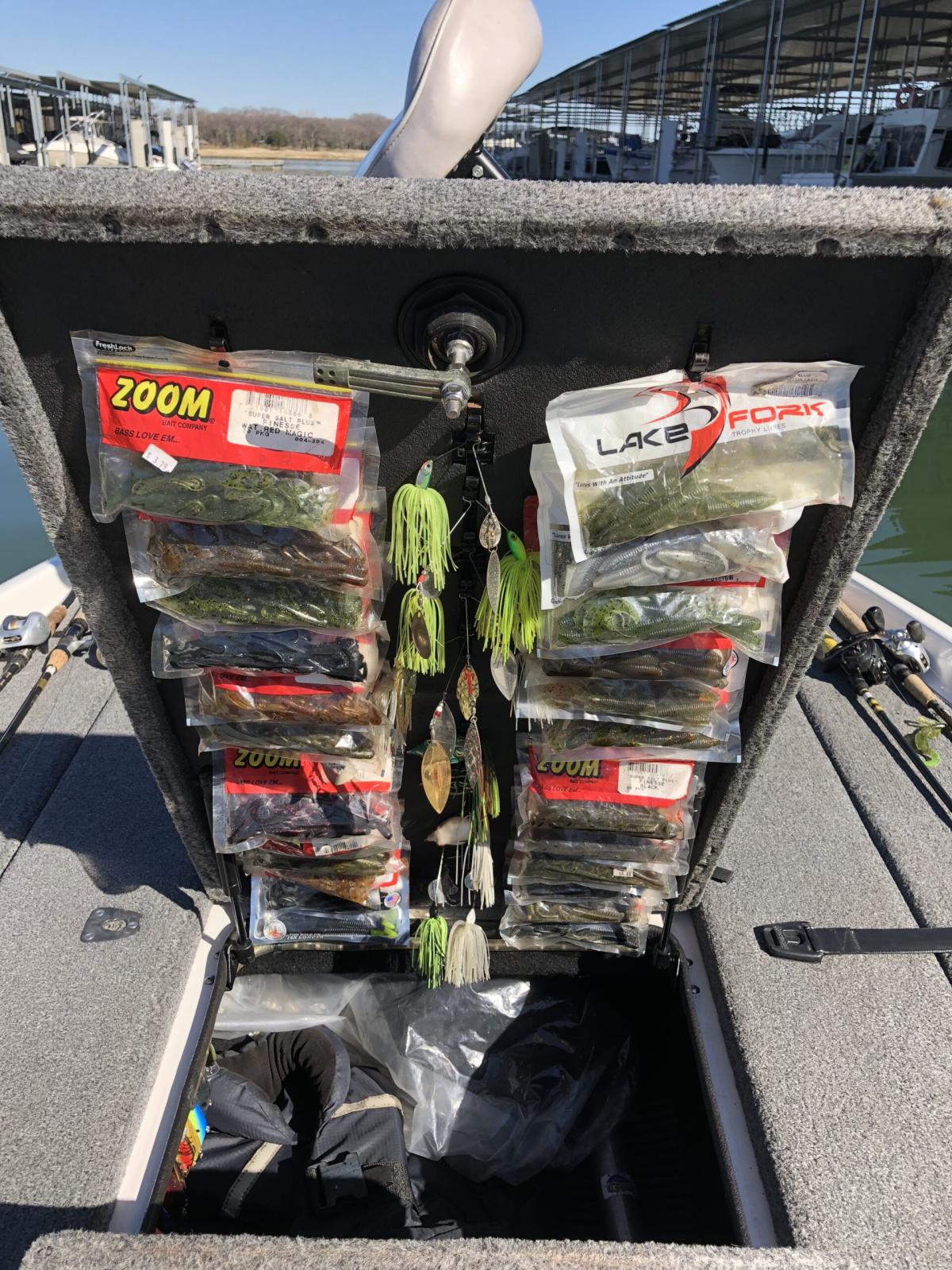
The clock is the real enemy. In tournament fishing, minutes spent digging through a compartment are minutes not spent casting at fish. Traditional tackle boxes and trays force you to lift, sort, and re-stack every time you change presentations.
Below, we’ll walk through seven steps to fix it, from auditing your gear to building a workflow that saves seconds on every cast.
Step 1: Audit Your Current Gear and Storage Space
Start by emptying every compartment and counting what you actually carry. Most anglers haul far more tackle than they use, and that surplus is what clogs the boat.
Lay everything out on the deck. Group it into crankbaits, soft plastics, spinnerbaits, buzzbaits, terminal tackle, and tools. Note which baits you reached for last trip and which haven’t moved in a season. That second pile is your clutter.
Then measure your storage honestly. Open every compartment lid, look under the consoles, and check the inside of rod locker doors. You’re hunting for flat, vertical surfaces that hold nothing right now.
Write down three numbers: how many baits you carry, how many you actually fish, and how many compartments sit half-empty. That gap tells you exactly how much room you can reclaim.
Step 2: Choose Bass Boat Tackle Storage Ideas That Use Vertical Space
The best bass boat tackle storage ideas turn walls and lids into working surfaces instead of floor space.
Look at your boat with fresh eyes. The underside of a compartment lid, the inside wall of a rod locker, and the face of a console all sit empty while your floor fills with boxes.
Here is a surface-by-surface playbook that most guides skip:
- Compartment lid undersides. These are the highest-value real estate on a bass boat because the lid swings up to eye level when you open it. A foam-filled crankbait hanger mounted here turns a lid into a display rack: open the lid, and a row of crankbaits hangs at chest height, bills down, hooks clear. Adhesive works well on a clean, flat, gel-coated lid interior; screw mounting is the safer call on lids that flex or take spray.
- Rod locker interior walls. The vertical wall inside a rod locker is usually flat and dry, which makes it a natural home for clip strips holding soft plastics, spinnerbaits, and buzzbaits. Because the locker is enclosed, baits stay out of sun and spray while still hanging dry and visible the moment you open the door.
- Console face and side panels. The face of a console is within arm’s reach of the driver’s seat, so it suits a short strip of confidence baits you can grab without leaving the wheel. Keep the strip narrow here so it doesn’t crowd gauges or throttle rigging.
- Under-deck and gunwale surfaces. Flat surfaces under the deck and along the inside of the gunwale are often overlooked. A clip strip here keeps terminal tackle and backup baits off the floor and out of the bilge splash zone.
Our clip strips and foam-filled crankbait hangers are designed for exactly this. For anglers working through the mounting side of this, our guide on how to mount tackle clips on your boat walks through the hardware step by step.
A few practical rules keep vertical storage working. First, mount hangers where the lid or door clears them when closed, test the swing before you commit adhesive. Second, keep heavy baits low and light baits high so a rough-water jolt doesn’t load a single strip. Third, leave the floor of each compartment clear so you can still slide in a bag of bulk plastics or a tool roll without knocking baits loose.
Small center console? This approach suits tight quarters because it uses surfaces you already own. You’re not adding a bulky unit; you’re converting dead wall space into hanging storage.
Step 3: Apply Best Practices for Lure Organization With Hanging Storage
Group baits so your hand knows where to go before your eyes confirm it.
Here are the best practices for lure organization we’d recommend:
- Hang crankbaits by running depth, shallow to deep, so you can adjust to a depth change in one motion
- Keep spinnerbaits and buzzbaits on separate clip strips so blades don’t tangle
- Face hooks inward or down so nothing snags a sleeve or a line
- Leave a gap between hangers so you can pinch and pull a bait cleanly
- Reserve one strip for your confidence baits, the ones you throw first
The payoff is speed. When every bait hangs dry and visible, you stop lifting trays and start reading the water. For a deeper look at tournament-ready setups, our article on the best lure hangers for bass fishing expands on these practices.
Step 4: Master Organizing Soft Plastics on a Boat Without Tangles
Organizing soft plastics on a boat comes down to one rule: keep each bait separate and let it hang. Soft plastics tangle when they’re piled, and a tangled bag costs you time and torn baits.
Soft plastics, spinnerbaits, and other hanging baits work well on our clip strips. Each bait clips in place, hangs straight, and stays separated from its neighbors. No more digging through a bag for a specific color while the school moves off the point.
Sort by type first, then by size. Keep your go-to creature baits and stickbaits on the strip closest to where you stand. Bulk extras can stay bagged in a compartment, because you rarely need them mid-pattern.
For a full walkthrough, see our guide on organizing soft plastics on a bass boat.
Step 5: Mount the Easy View Tackle System for Rough Water
Secure mounting is what separates a system that survives chop from one that scatters across the deck. Rough water tests every adhesive and every screw, so mount with that in mind.
Our patent-design system includes hardware for adhesive or screw mount application. Clean and dry the surface first, and let adhesive set before you load it.
You can see the full Easy View Tackle System and how the clip strips and foam-filled hangers fit together. If you want the detailed mounting sequence, our installation guide covers surface prep and hardware choices.
Step 6: Maintain Your System for Saltwater and Freshwater
Maintenance is the step almost everyone skips, and it’s where saltwater boats fall apart. Salt spray and humidity attack hooks, clips, and hardware faster than freshwater ever will. Most storage content treats saltwater and freshwater as the same problem; they aren’t, and the difference changes how you care for a hanging system.
Saltwater: the corrosion problem is airflow and residue. Salt doesn’t just sit on a hook, it pulls moisture out of humid air and keeps the metal wet long after the spray dries. That is why a bait sealed in a damp box rusts faster than one hanging in open air. A hanging system helps because baits dry on the hanger instead of stewing in a closed compartment, but it still needs a routine:
- Rinse baits, hooks, and clip strips with fresh water after every saltwater trip, then let them hang dry before they go back in the compartment.
- Wipe mounting hardware and screw heads dry; salt residue collects in the recesses where a rag doesn’t reach unless you look for it.
- Check clip strips for stiffness or grit. A clip that stops snapping cleanly is a clip that will drop a bait in the bilge.
- Leave compartment lids cracked open at the dock so humid air can move through instead of condensing on hardware overnight.
Freshwater: the problem is heat and trapped moisture, not salt. A wet, humid weekend followed by a closed lid creates the warm, damp pocket where mold and rust start.
The maintenance schedule that actually gets followed. A common pattern among tournament anglers is a quick post-trip check and a deeper monthly one:
- After every trip: rinse if saltwater, air out compartments, and glance at clips for looseness.
- Every few trips: check mounting hardware for looseness and re-tighten screws before a strip starts to sag.
- Monthly: pull baits off the strips, wipe the strips and mounting surfaces, and inspect hooks for the first sign of rust before it spreads to neighboring baits.
Watch out: putting a wet bait back on a strip and closing the lid traps moisture against the hardware, dry it first or hang it loose until it airs out.
Here is the maintenance routine the article recommends, broken down by timing and water type.
| Timing | Task | Note |
|---|---|---|
| After every trip | Rinse baits, hooks, clip strips with fresh water | Saltwater trips only, then hang dry |
| After every trip | Air out compartments and glance at clips | Check clips for looseness |
| Every few trips | Check mounting hardware and re-tighten screws | Before a strip starts to sag |
| Monthly | Pull baits, wipe strips and mounting surfaces | Inspect hooks for first sign of rust |
| At the dock | Leave compartment lids cracked open | Lets humid air move through |
| Freshwater trips | Open compartments after a wet trip | Heat and trapped moisture cause mold and rust |
Step 7: Build an Ergonomic Workflow That Saves Seconds Every Cast
Ergonomics on a boat means arranging gear around your body, not around available space. Put the baits you throw most within arm’s reach of where you stand, and the rest within a step.
Map your day. You cast from the front deck, tie on at the console, and net fish at the side. Place your confidence baits, hook storage, and leader line management where those actions happen. Keep terminal tackle in one predictable spot so you never hunt for a hook.
Then practice the reach. A bait you can grab without looking is a bait you can change in seconds. Multiply that across a tournament day and the savings add up.
Onboard efficiency isn’t about doing more. It’s about removing the small frictions that steal casts.
The Bottom Line on Boat Tackle Storage
The anglers who win aren’t the ones with the most tackle. They’re the ones who can find the right bait fastest.
If your boat still buries lures in stacked trays, you’re giving away seconds on every cast. Easy View Tackle builds a patent-design system of foam-filled crankbait hangers and clip strips that mount inside compartments and under lids, keeping every bait dry, visible, and ready to grab, with hardware for adhesive or screw mounting and a layout you can customize to your boat and fishing style. Get started with Easy View Tackle and spend less time hunting for gear and more time fishing.
Frequently Asked Questions
How much does it cost to set up Easy View Tackle for a boat?
Pricing depends on how many clip strips and foam hangers you need for your compartments. Easy View Tackle does not publish fixed package prices because every boat and fishing style requires a different mix. Visit easyviewtackle.com for current pricing and to build a setup that fits your storage space.
Will the adhesive mounts hold up in rough water?
Easy View Tackle includes hardware for both adhesive and screw-mount applications. Follow the installation instructions for surface prep and let adhesive cure fully before loading baits.
Does the system handle soft plastics and smaller tackle, or just crankbaits?
The patent-design clip strips hold soft plastics, spinnerbaits, buzzbaits, and other hanging baits, while foam-filled crankbait hangers protect treble hooks. You can customize each compartment to match the baits you throw most.
How do I organize boat tackle storage in a small center console?
Use vertical space inside compartment lids and on bulkheads. Easy View Tackle clip strips and foam hangers mount inside storage compartments and under lids, so they do not eat up floor space. Measure your compartments first, then place strips where you can grab baits without moving other gear.
